
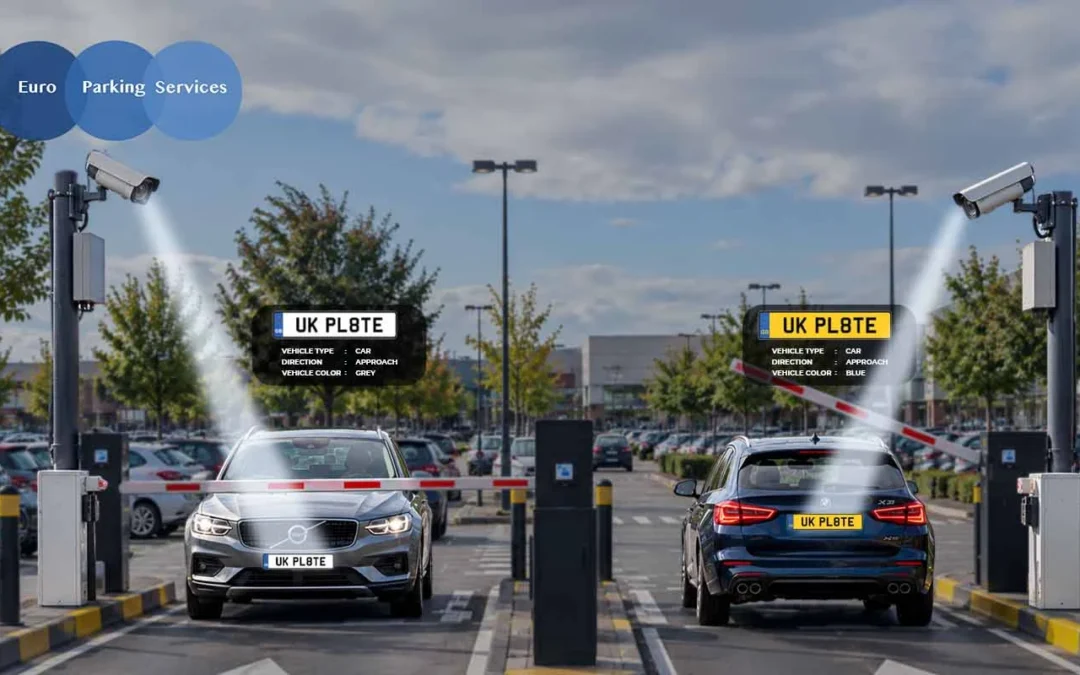

Most conversations about ANPR parking start with the camera: resolution, infrared, frames per second. But the camera is the easy part.
Automatic Number Plate Recognition (ANPR) turns a photo of a registration plate into text. That is useful, but a string of characters on its own doesn’t run a car park. What matters is what is happening in the next two seconds, and what happens when the read is wrong.
If you manage a site, that is the difference between an ANPR car park system that quietly saves you time and one that creates a steady stream of complaints.
What is ANPR parking?
ANPR parking uses cameras and image-processing software to read vehicle registration plates as cars enter and leave a car park. The system converts each plate into data that can be used to:
- Record entry and exit times
- Manage access for permit holders, visitors and contractors
- Match vehicles to payments or bookings
- Monitor how a site is being used
- Reduce manual vehicle checks
For drivers, it usually means no tickets and fewer steps. Arrive, park, pay if needed, leave.

A plate read is not a decision
Behind that simple experience, a good number plate recognition system works through several stages every time a vehicle passes:
- Detects that a vehicle and plate are in frame.
- Read the characters using optical character recognition (OCR).
- Score how confident the system is in that read.
- Match the result against permits, payments, bookings or whitelists.
- Act open a barrier, start a session, flag an exception, or do nothing.
Plenty of cameras can read a clean plate in good light. The real quality gap sits in steps three to five: what the system does with a read it isn’t sure about.
Why number plates get misread
Real car parks aren’t test labs. The usual culprits are:
- Look-alike characters. O and 0, I and 1, B and 8, S and 5.
- Dirt, damage and wear. Winter grime, cracked plates, faded print.
- Non-standard plates. Custom fonts, unusual spacing and novelty styles.
- Difficult conditions. Low sun, headlight glare, heavy rain, night-time reflections.
- Angles and obstructions. Tow bars, bike racks, fast-moving vehicles.
- Different formats. Foreign vehicles and two-line motorcycle plates.
No ANPR system reads everything perfectly, and any provider who tells you otherwise isn’t being straight with you. The better question is how the system copes when it doesn’t.
What separates a good ANPR parking system from an average one
Confidence-based handling. Not every read deserves equal trust. High-confidence reads flow straight through, while uncertain ones can be sent for a second check instead of turning into a wrong decision.
Smart matching. If a driver paid for AB12 CDE and the camera read AB12 CDF, a rigid system calls that unpaid. A well-designed one recognises a likely near-match, uses context such as timing and session data, and flags it for review rather than escalating automatically.
Clear evidence. Every event should be backed by an image, a timestamp and an audit trail, so exceptions can be resolved quickly and fairly.
A sensible human fallback. The goal isn’t to remove people. It’s to make sure their time goes on the cases that need judgement, not on checking every vehicle.
The system around the camera matters more
ANPR only becomes truly useful when it connects with the rest of your car park management:
Parking payments: matching a session to a payment, even when a driver mistypes their registration.
Permits and access: handling renewals, visitors and contractors without a spreadsheet.
Exception handling: giving staff a clear queue of issues instead of raw data.
Reporting: turning entry and exit data into insight on occupancy, peak times and length of stay.
A fast camera with weak integration simply produces data faster than anyone can use it.
Getting the human side right
Parking is an everyday frustration, and mistakes feel personal. A wrongly issued charge costs a driver time and trust, and costs the operator its reputation. Good ANPR practice includes:
- Clear signage and plain-English terms
- Data kept only as long as it’s needed and handled in line with data protection requirements
- An easy, visible way for drivers to query or challenge an outcome
- Regular checks on how the system is performing on site, not just on installation day
Accuracy and fairness are really the same goal.
7 questions to ask any ANPR provider
Before choosing a system, ask:
- How does it handle low-confidence reads?
- How are near-miss registrations treated?
- What evidence is kept for each event, and for how long?
- How does it perform in poor light, bad weather and at awkward angles?
- How are exceptions surfaced to staff?
- How easily does it connect to payments, permits and reporting?
- How is performance monitored after installation?
A good provider will answer these plainly and be happy to show you how the system behaves on a real site. If you get headline accuracy claims and camera specifications instead, it’s worth asking again. How a system handles the reads it gets wrong tells you far more than how it handles the ones it gets right.
How we approach ANPR at Euro Parking Services
At Euro Parking Services, we don’t see ANPR as a camera, and we don’t think the camera is where the value lies. We focus on the whole journey: getting the everyday experience right for drivers, giving operators clear visibility, and handling the awkward cases with care.
Because the best parking technology isn’t the kind that never makes a mistake. It’s the kind that’s built to catch them.
Want to see how ANPR could work on your site? Get in touch with Euro Parking Services to talk through your car park.